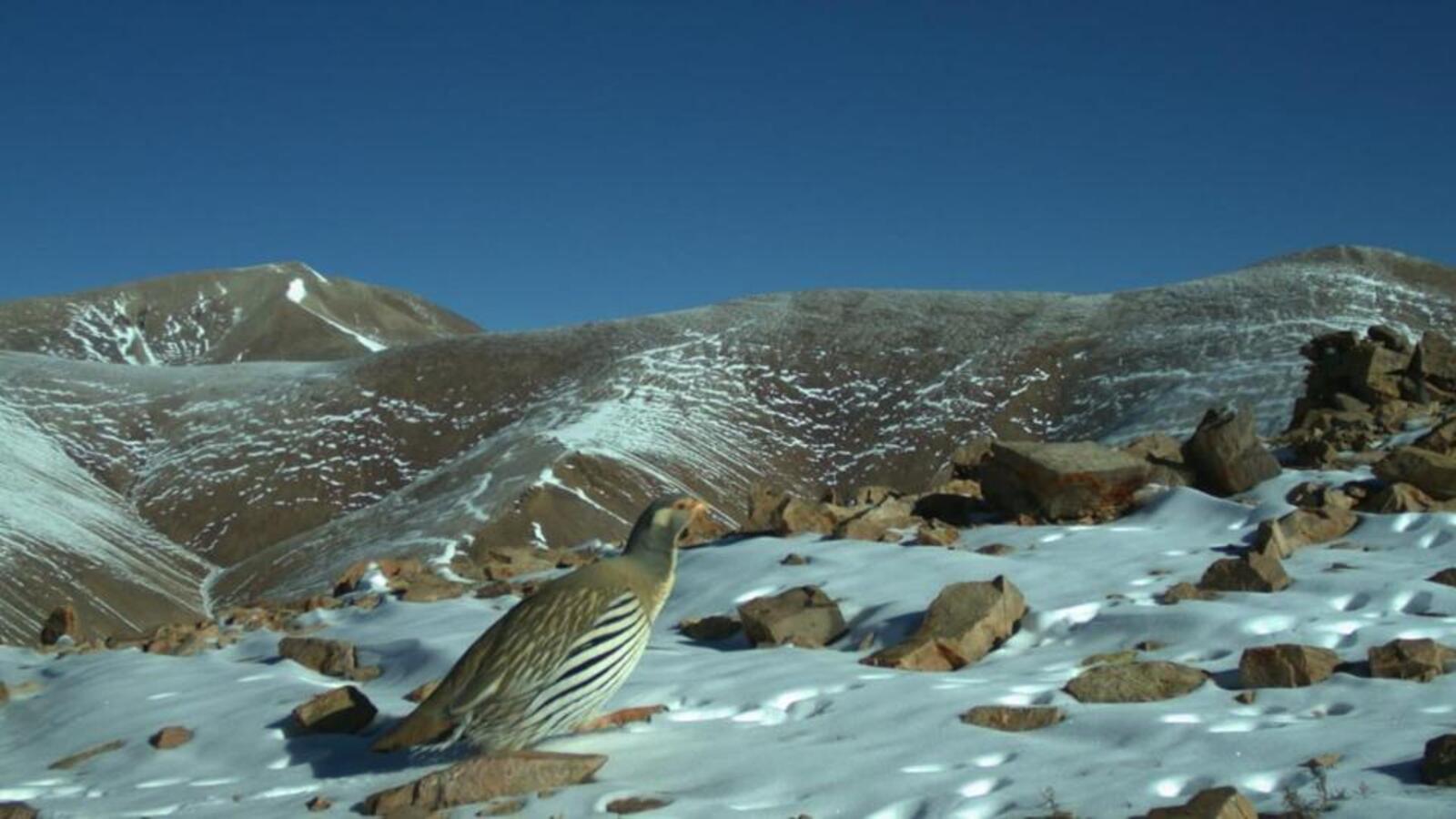
A new study by scientists from the Wildlife Institute of India (WII) has found that nearly half the bird species recorded on camera traps in Uttarakhand's high-altitude Gangotri landscape were documented above their previously published upper elevational limits. The study examined 551 confirmed detection events across 55 species, gathered over three years between 2016 and 2018 from 228 camera trap stations at elevations of 2,500 to 5,250 metres in the Bhagirathi river basin, covering parts of Gangotri National Park and adjoining areas of the Uttarkashi Forest Division. It was published online on November 19, 2026, in the journal Environmental Monitoring and Assessment.
Of the 55 species detected, 26 were recorded at least once above their published upper elevational limits, accounting for 137 above-limit records overall, while 14 species showed repeated above-limit detections across multiple camera stations. These included the Olive-backed Pipit, Trumpeter Finch, Himalayan Beautiful Rosefinch, Pink-browed Rosefinch, Snow Pigeon, Plain Mountain Finch, Himalayan Monal, Black-winged Snowfinch, Tibetan Snowfinch, Blue Whistling Thrush, Rufous-vented Tit, Black Redstart, Black-throated Accentor and Himalayan Snowcock, according to project scientist Vineet Dubey.
Some species appeared far higher than their published limits, including the red-wattled lapwing (maximum exceedance of 3,286 m), Brahminy starling (2,466 m) and Olive-backed Pipit (2,091 m). The study noted that several of these large exceedances came from small numbers of detections and require verification rather than being treated as direct evidence of long-term shifts. Detections checked against mapped IUCN geographic ranges also showed individual sightings extending beyond those boundaries.
Dubey said targeted bird surveys and repeated observations would be needed to determine whether these records represent persistent local populations, transient occurrences or gaps in existing distributional information. He added that though the Himalayan region is widely recognised as sensitive to warming, the researchers cautioned against treating these snapshots as proof of recent, climate-driven upward range shifts. The researchers also noted that camera traps were originally set up primarily for large mammals and ground-dwelling Galliformes, making bird records incidental.