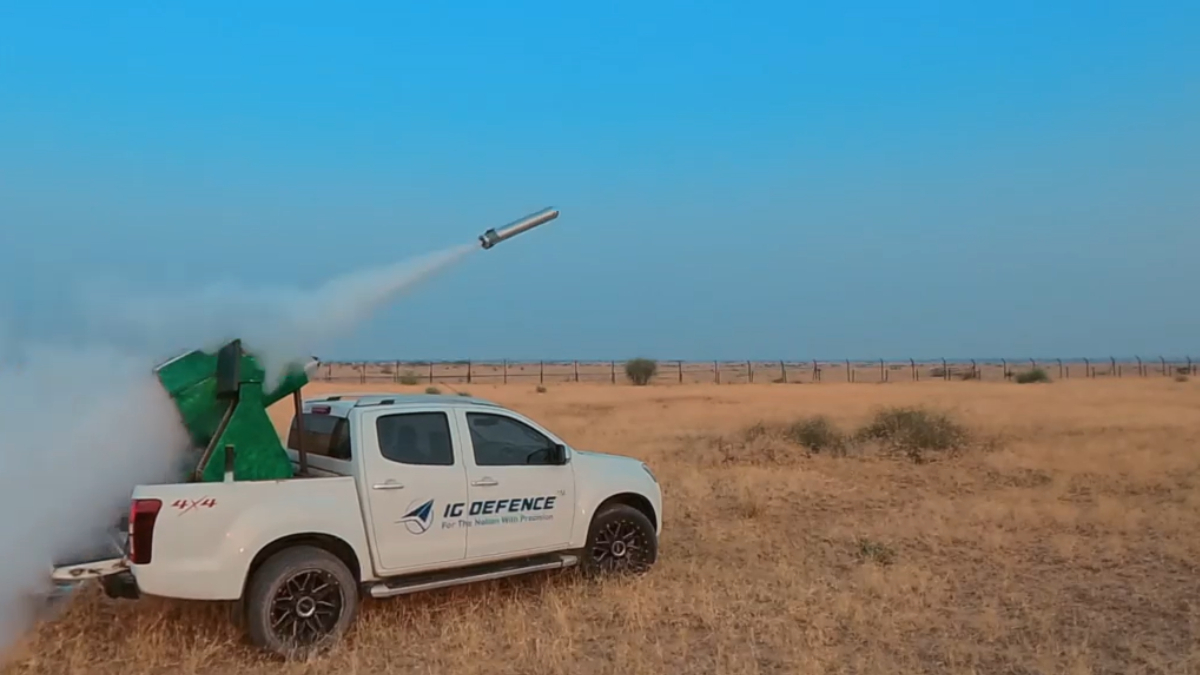
Indigenous defence manufacturer IG Defence has successfully test-fired the JWALA MK-1 at the Pokhran firing range in Rajasthan. The company describes it as India's first autonomous Counter-Unmanned Aircraft System (CUAS) Micro-Missile System, calling it a significant milestone in the development of next-generation indigenous counter-drone technologies. According to the company, the system has an operational range of up to 5 kilometres and is an indigenous, autonomous and cost-effective solution to address the rapidly evolving threat posed by hostile unmanned aerial systems.
According to IG Defence, the missile uses a dual-pulse solid rocket motor and aerodynamic fin controls for propulsion and flight manoeuvrability. It carries a pre-fragmented high-explosive warhead and a proximity fuse, allowing it to detonate near a target rather than relying entirely on direct impact. The company said the system identifies potential hostile drone targets, classifies them and facilitates airborne neutralisation through an integrated mission autonomy architecture.
The development comes amid growing concern over the cost imbalance in modern warfare, where relatively inexpensive attack drones can force militaries to deploy far more expensive interception systems. Recent international conflicts, including the US-Iran confrontation, have highlighted the growing deployment of low-cost attack drones and the economic challenges of countering them with high-cost conventional air-defence interceptors. For India, with its complex security environment and evolving aerial threats, developing affordable, scalable and indigenous counter-UAS technologies is seen as a strategic necessity.
The test-firing is being viewed as a boost to the Atmanirbhar Bharat mission in defence. Earlier, Defence Minister Rajnath Singh said India's bid to achieve 'aatmanirbharta' in defence is entering the "second phase" and called on all stakeholders to develop top-end and state-of-the-art technologies in the sector.