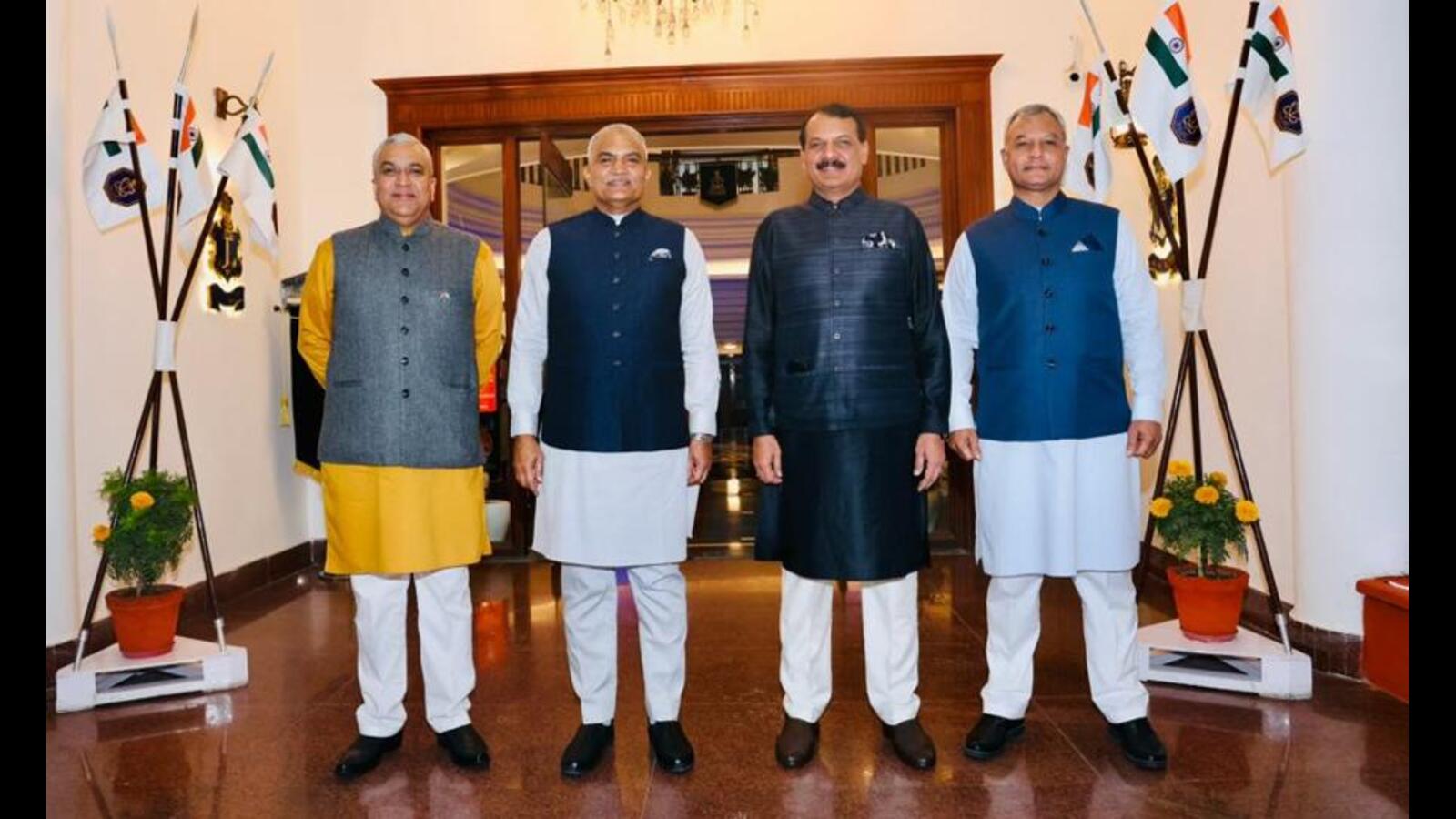
Nearly three years after the Navy relaxed its dress code to allow Indian attire in officers' messes, the option has found few, if any, takers, officials aware of the matter said on Friday. The change was introduced in February 2024, when Admiral R Hari Kumar was at the Navy's helm, amid a broader push to indigenise the service's traditions and practices.
According to one of the officials, the traditional ensemble of kurta-pyjamas and sleeveless jackets with formal shoes or closed sandals has barely made an appearance in Navy officers' messes, and the conventional shirt-and-trouser combination paired with formal shoes remains the norm at functions where officers are required to wear civil dress. A second official said the instructions allowing Indian attire in officers' messes remain in force. Several officers said they had not seen Indian attire at mess gatherings, except in a March 2024 photograph featuring Admiral Hari Kumar, his successor and the most recently retired Navy chief, Admiral Dinesh K Tripathi, along with other senior officers. The Army and Air Force do not permit such attire in their messes.
Much of the "Indianisation" in the military began five years ago, when Prime Minister Narendra Modi called for erasing colonial customs and adopting Indian ways in the armed forces at the Combined Commanders' Conference in Kevadia, Gujarat. His remarks at the March 2021 conference indicated that many colonial practices in the armed forces were ending, and he underlined the importance of enhancing indigenisation in the national security system, not just in sourcing equipment and weapons but also in doctrines, procedures and customs. This prompted the three services to identify customs seen as out of step with Indian culture.
As part of its push to shed colonial-era practices, the Navy adopted a new ensign, did away with batons for commanders and allowed officers to wear Indian attire in messes. It dropped a much-hyped plan to indigenise the ranks of its non-officer cadre, as first reported, and is no longer pushing to rename ranks along Indian traditions because the defence ministry believes any change in nomenclature should be implemented uniformly across all three services, rather than as a navy-specific initiative. The rank revamp would have covered more than 65,000 sailors, with officer ranks excluded from the review. The ranks slated for renaming included Master Chief Petty Officer First Class, Master Chief Petty Officer Second Class, Chief Petty Officer, Petty Officer, Leading Seaman, Seaman First Class and Seaman Second Class; according to internal feedback, the "petty officer" ranks were especially unpopular among those who held them.