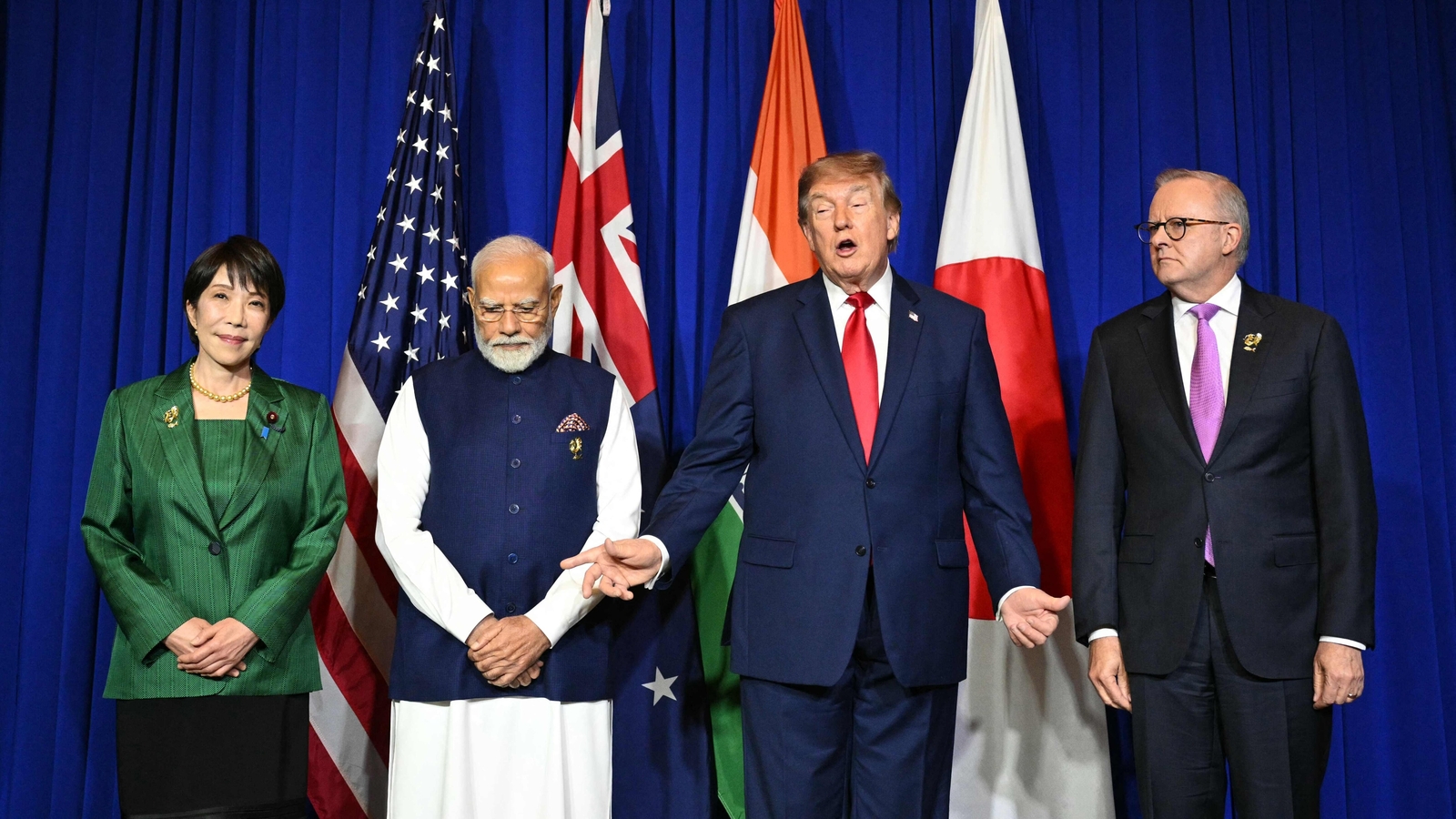
Leaders of the four Quad nations met in Manila on Tuesday for their first summit in over two years, reaffirming their commitment to a free and open Indo-Pacific and announcing new initiatives on maritime surveillance, trade and connectivity. Prime Minister Narendra Modi joined US President Donald Trump, Australian Prime Minister Anthony Albanese and Japanese Prime Minister Sanae Takaichi at the Quad Leaders Summit. Without naming China, the grouping opposed unilateral actions to alter the status quo by force or coercion and expressed concern over economic coercion, including arbitrary export restrictions.
In his opening remarks, Modi described the Quad as a constructive and trusted partnership for India, covering maritime security, trusted supply chains, new technologies and disaster response. He announced that Mumbai will host the inaugural Quad Business Leaders Forum in early 2027, which a joint press release said will bring together business leaders, government officials and policy experts to promote commercial deals and partnerships. Trump said the grouping will hold its first military exercise with maritime patrol aircraft to "protect peace through strength".
The Indo-Pacific Maritime Surveillance Collaboration, which builds on the Quad's earlier maritime domain awareness initiative, aims to strengthen information-sharing and maritime awareness. According to Foreign Secretary Vikram Misri, P-8 and P-3 maritime patrol aircraft of the four countries will join a maritime exercise for the first time in a Quad context, to be held on the sidelines of Exercise Sea Dragon in Guam in March 2027 to address shared challenges such as illegal fishing and trafficking.
The leaders also announced an expansion of the Quad Partnership for Cable Connectivity and Resilience to cover undersea energy cables, and welcomed upcoming undersea cable projects in the Indian Ocean. The Quad acknowledged a rapid increase in the number and scale of cyber incidents in the region and announced enhanced cybersecurity cooperation. In the joint press release, the nations described the grouping as a "force for good and a partnership of action" and expressed grave concerns about economic coercion, including through arbitrary export restrictions.