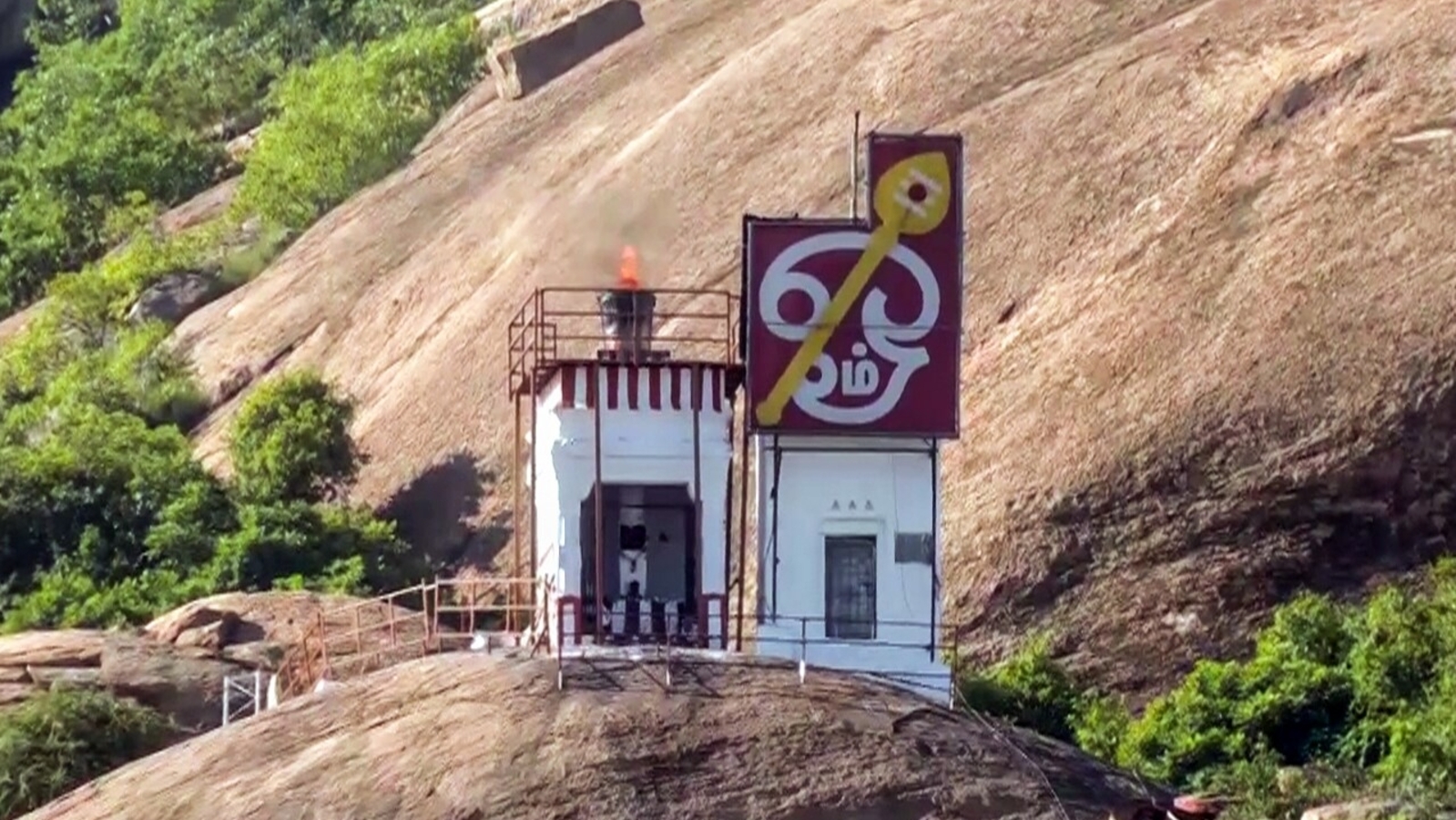
The Supreme Court on Friday came down heavily on the Tamil Nadu government and temple authorities for failing to implement its November 20 order permitting the lighting of the Karthigai Deepam at the disputed stone pillar, or Deepathoon, on Thiruparankundram hill. According to LiveLaw, a bench of Justices Aravind Kumar and Vipul Pancholi said the chain of events indicated that executive authorities "seem to have acted at the dictates of their political bosses," and that this had to be unearthed to preserve the dignity of the court and the purity of justice. Bar and Bench reported that the bench observed the officials' conduct prima facie revealed "administrative chaos" in Tamil Nadu, or at least in Madurai district.
The court ordered that a ceremonial lamp be lit atop the disputed pillar once again on Saturday, November 28, and issued contempt notices to senior Tamil Nadu officials, including the chief secretary, the director general of police, the HR&CE department secretary and commissioner, the Madurai district collector and superintendent of police, the temple CEO, and the chairperson and trustees of the temple board. The chief secretary has been directed to appear before the court on December 15 and file an affidavit detailing communications between officials on implementing the order. The bench also suspended the temple's board of trustees and appointed former Madras High Court judges Justices S Vaidyanathan and V Parthiban as receivers to oversee its administration.
Invoking Article 129 of the Constitution, the bench said the judiciary cannot remain silent when its orders are flouted, adding that the Contempt of Courts Act, 1971, was enacted to assure the people that the administration of justice will not bow to any authority. It stated that an order of the court "is not an invitation to negotiate" and binds the State, its officers and every statutory or religious institution until the court itself modifies it, warning that the time had come to deal with such situations "with an iron hand" to avoid constitutional chaos.
Finding a prima facie case of contempt, the court said the conduct alleged appeared to show "a brazen and wilful disobedience" of its order, a flagrant disregard of an undertaking given before the High Court and a calculated affront to the authority of both constitutional courts. It warned that any attempt to pollute the stream of justice by any person, however high, would not be tolerated.