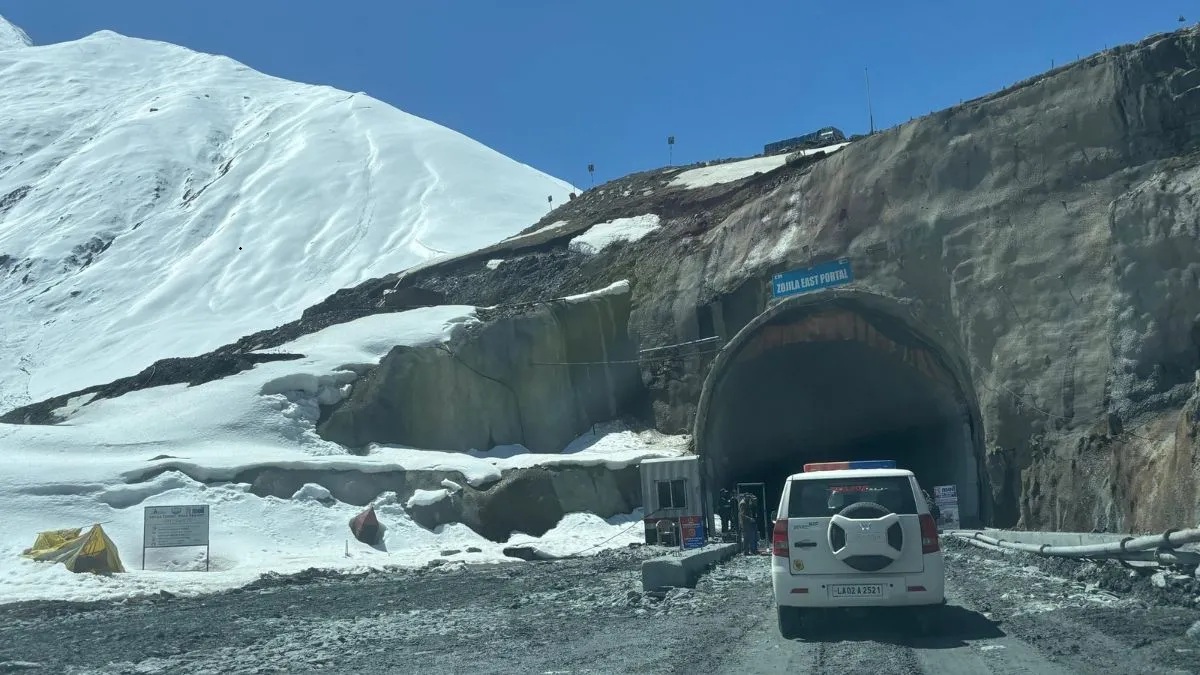
Union Road Transport and Highways Minister Nitin Gadkari has said Asia's longest Zojila Tunnel, which will provide all-weather connectivity between Srinagar and Ladakh, is expected to be completed in the next six to eight months. Speaking at the 7th World Landslide Forum on Tuesday, he said around 70 per cent of the work on the project had been finished. He also underlined the need to factor in geology, hydrology and slope stability while building infrastructure in difficult mountain terrain, and said advanced technologies and long-term monitoring are essential to keep such structures safe and durable.
The project crossed a major milestone on June 9 this year when excavation of the tunnel, spanning more than 13 kilometres, was completed. A breakthrough is achieved when digging teams working from opposite ends meet at a designated point, completing the underground passage. The tunnel is 13.153 kilometres long, 9.5 metres wide and 7.57 metres high, and is being built at an altitude of about 11,578 feet above sea level. The horseshoe-shaped, single-tube, two-lane structure is estimated to cost Rs 6,500 crore.
Located on the Srinagar-Leh National Highway, the tunnel is expected to cut travel time on the difficult Zojila stretch from about one to one-and-a-half hours to roughly 15 minutes. It is being constructed between Baltal in Ganderbal district of Jammu and Kashmir and Minamarg in Ladakh's Drass district, and the project includes an 18-km access road. Along with access roads and bridges, the overall infrastructure work extends across approximately 31 kilometres between Sonamarg and Minamarg.
The Zojila Pass route is often disrupted in winter by heavy snowfall and typically remains closed to traffic for around three months a season, affecting civilian travel, tourism, the transport of essential supplies and the movement of military personnel. The tunnel is expected to offer a dependable all-weather link between Kashmir and Ladakh and to strengthen strategic mobility for the Indian Army along the route.