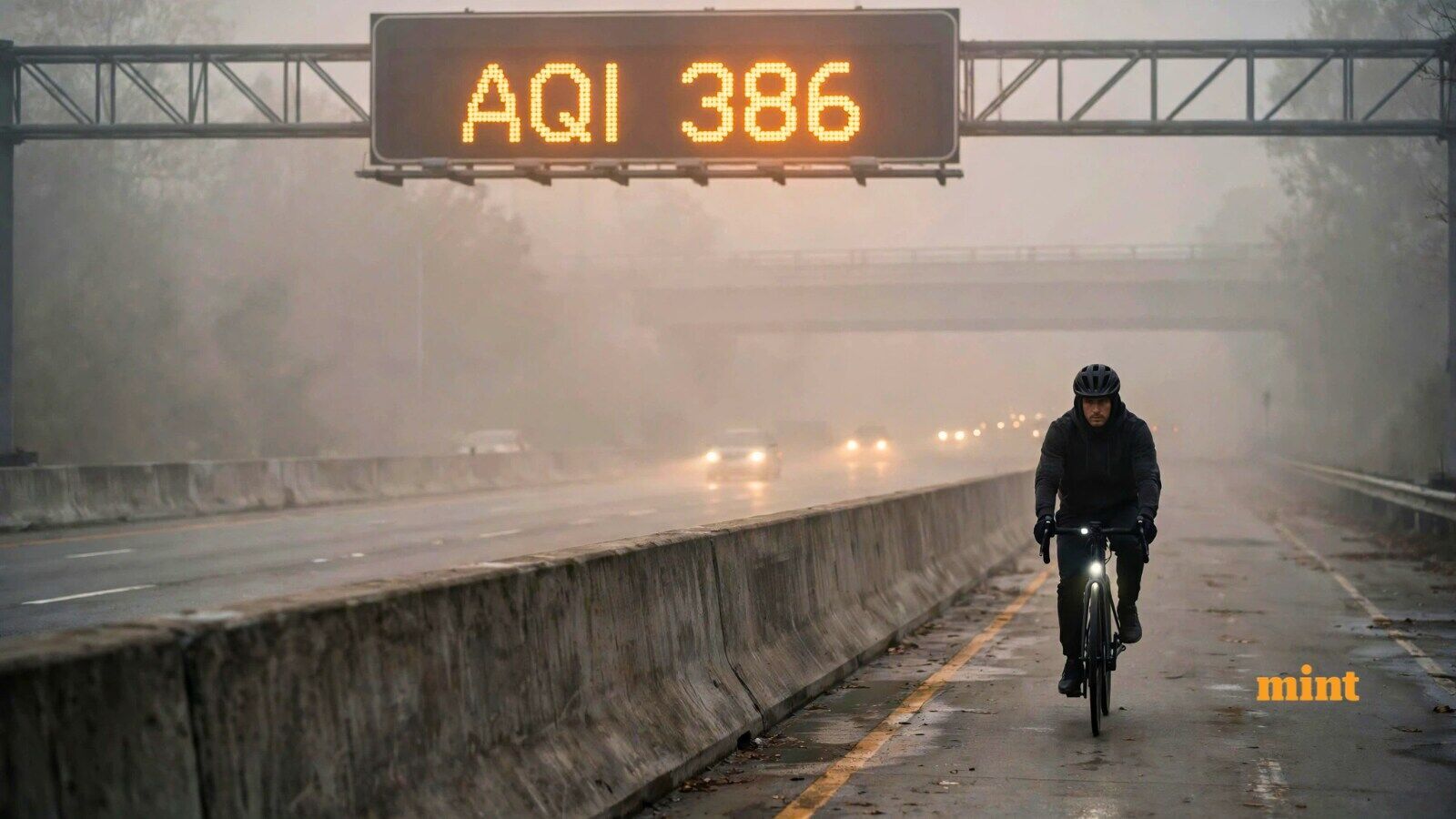
Delhi’s Air Quality Index stood at 386 at 8:31 AM on Sunday, 22 November, placing the capital in the hazardous category on the US AQI scale, which begins at 301. The reading was 85 points above that threshold, and a smoky haze accompanied the morning pollution. New Delhi ranked 14th among the world’s most polluted cities in the morning rankings. At the time of the reading, the temperature was 18°C, humidity 67% and wind speed 3.6 km/h, with an ultraviolet index of 0.5.
PM2.5 concentration was 267 micrograms per cubic metre, while PM10 measured 374 micrograms per cubic metre. Carbon monoxide stood at 2,105 parts per billion, nitrogen dioxide at 16 parts per billion, sulphur dioxide at six parts per billion and ozone at two.
Among eight Indian metros, Delhi recorded the highest AQI. Chennai followed at 240, Mumbai at 210, Pune at 207 and Bengaluru at 205. Ahmedabad stood at 195 and Hyderabad at 171, while Kolkata had the lowest at 109. Four of the other seven metros recorded readings above 200.
Delhi’s AQI had eased in the three days before Sunday, from 353 on 19 November to 341 on the 20th and 313 the following day, a 40-point fall over two days. Sunday’s live reading was 73 points above Saturday’s daily figure. Earlier, Delhi recorded 666 on 9 November, the highest daily reading through 21 November, and 547 on 12 November. The lowest was 224 on 17 November, followed by 273 on 18 November. Delhi recorded an AQI above 300 on 18 of the first 21 days of November, with all three days below 300 falling between 15 and 18 November. Using Berkeley Earth’s method, the AQI.in tracker estimated exposure equivalent to smoking 8.7 cigarettes daily, based on the average PM2.5 concentration over the previous 24 hours and assuming continuous exposure.