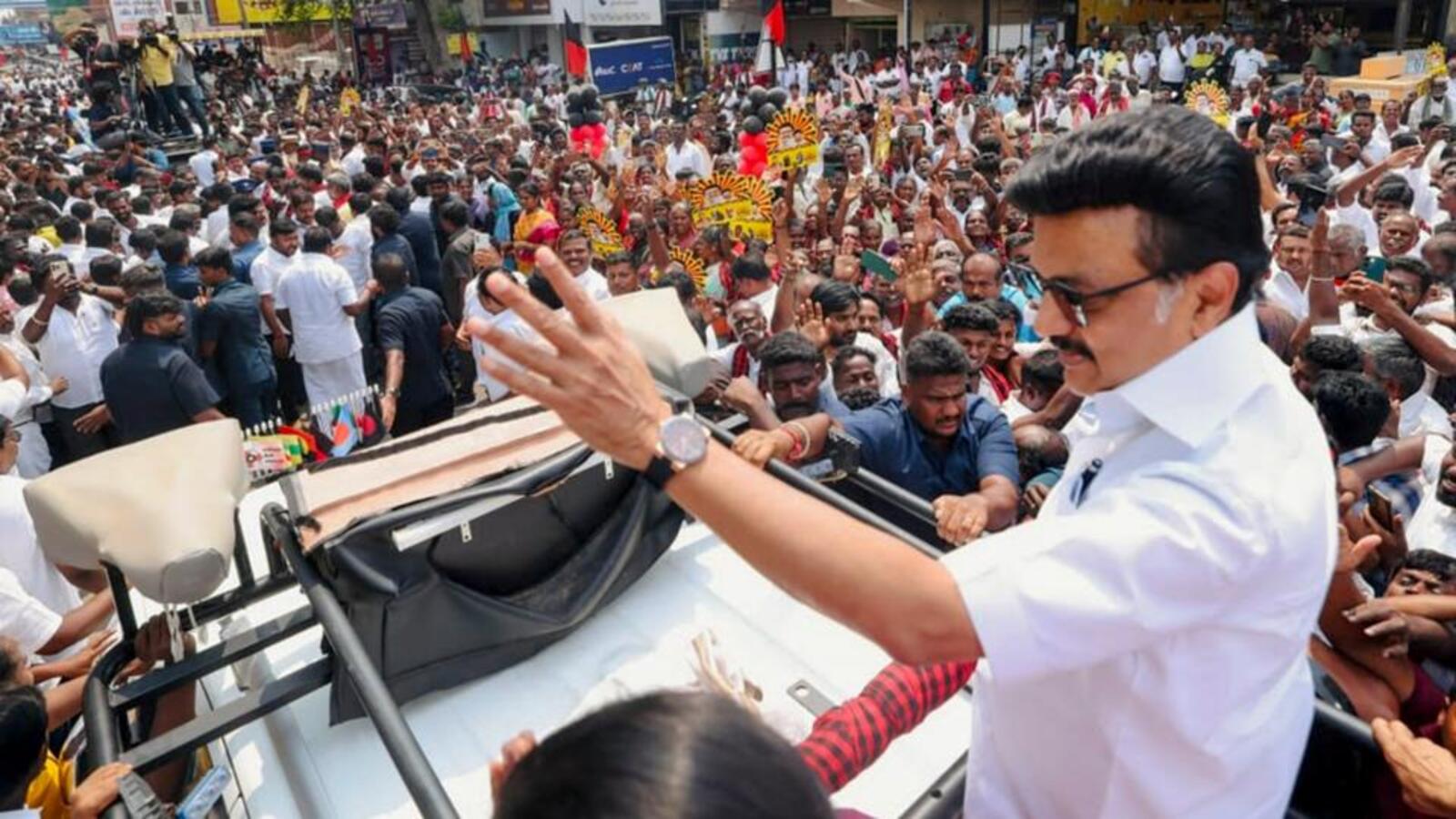
The Dravida Munnetra Kazhagam (DMK), with 22 MPs and the fifth-largest party in the Lok Sabha, is seen as pivotal to the Constitution amendment bill linked to the government's delimitation plan, which needs a two-thirds majority in the House. A fresh legislation is set to be introduced in a special sitting of Parliament beginning November 30, departing from the Constitution amendment bill introduced in April, which had sought to facilitate the implementation of women's reservation but did not mention in writing a uniform 50% rise in seats across states or an extension of the delimitation freeze. That bill failed to secure the required two-thirds majority in the Lok Sabha on April 17, and the DMK had voted against it.
DMK president MK Stalin said on Friday that the party stood firm on two demands: that Tamil Nadu's share of Lok Sabha seats remain at 7.18%, even if the total number of constituencies is increased, and that the existing proportion of parliamentary representation among states be frozen for another 25 years. The new bill retains the 1971 Census as the basis for allocating Lok Sabha seats among states, while providing for the redrawing of constituencies within states based on the latest published census figures, prompting the DMK to extend its support to the bill on Friday.
Whether the DMK will join the Bharatiya Janata Party (BJP)-led National Democratic Alliance (NDA) is a bigger question. Given the DMK's recent political positioning, the idea may seem improbable, and DMK and BJP leaders have had public spats on issues such as Hinduism. A closer look at history, however, suggests there would be nothing unprecedented about the DMK joining hands with the BJP. It was the fourth-largest ally of the BJP-led NDA in the Atal Bihari Vajpayee government, which took office in 1999 with 12 MPs in the Lok Sabha.
Regional dynamics, more than ideology, played a role in the 1999 alliance. The BJP contested the 1998 Lok Sabha elections in Tamil Nadu in an alliance with the All India Anna Dravida Munnetra Kazhagam (AIADMK). The AIADMK-led alliance won 29 out of the 39 PCs in the state, and the AIADMK was the second-largest alliance partner in the NDA, with 18 MPs of its own in the Lok Sabha. In April 1999, the AIADMK withdrew its support from the NDA, and the Vajpayee government lost the confidence vote in the Lok Sabha by just one vote. The 1999 Lok Sabha elections saw a political realignment in Tamil Nadu, with the BJP and DMK joining hands while the AIADMK allied with the Congress and the Left parties. The DMK-BJP alliance, however, ran into rough weather by the 2001 assembly elections, which the AIADMK swept while contesting in an alliance with the Congress, Left parties and regional parties. The DMK went back to the Congress in the 2004 Lok Sabha elections and has fought every Lok Sabha election since then, except in 2014, in an alliance with the Congress. The DMK-Congress alliance had a comfortable run in the 2019 Lok Sabha, 2021 Assembly and 2024 Lok Sabha elections. But that partnership ended in 2026 when the DMK-led alliance lost the elections and TVK emerged as the single-largest party in the assembly, falling just 10 short of the majority mark. The Congress, which had five MLAs in the assembly, ditched the DMK to join the TVK government. This was the moment that led to the DMK distancing itself from the INDIA bloc and opening the possibility of it supporting the bill.
If the DMK does switch camps outright, it should not surprise anyone familiar with the history of regional parties in India. Realpolitik often appears to prevail over larger principles such as safeguarding democracy and secularism in determining parties' political choices. For what it is worth, it was the Congress that brought down a non-BJP United Front government in 1997 when it withdrew support, citing the interim report of the MC Jain Commission, which investigated the 1991 assassination of former Prime Minister Rajiv Gandhi. The report was leaked to the media and subsequently tabled in Parliament. It made serious observations about the DMK leadership's alleged tacit support for the LTTE (Liberation Tigers of Tamil Eelam), the militant organisation responsible for Gandhi's assassination. The DMK, in its 70-year-long political history, has entered into various alliances, even before the 1990s. It first contested the Lok Sabha elections in 1962 (it also fielded candidates in 1957, but they contested as Independents), when it joined hands with the Swatantra Party, led by C Rajagopalachari, and the Muslim League in several constituencies.