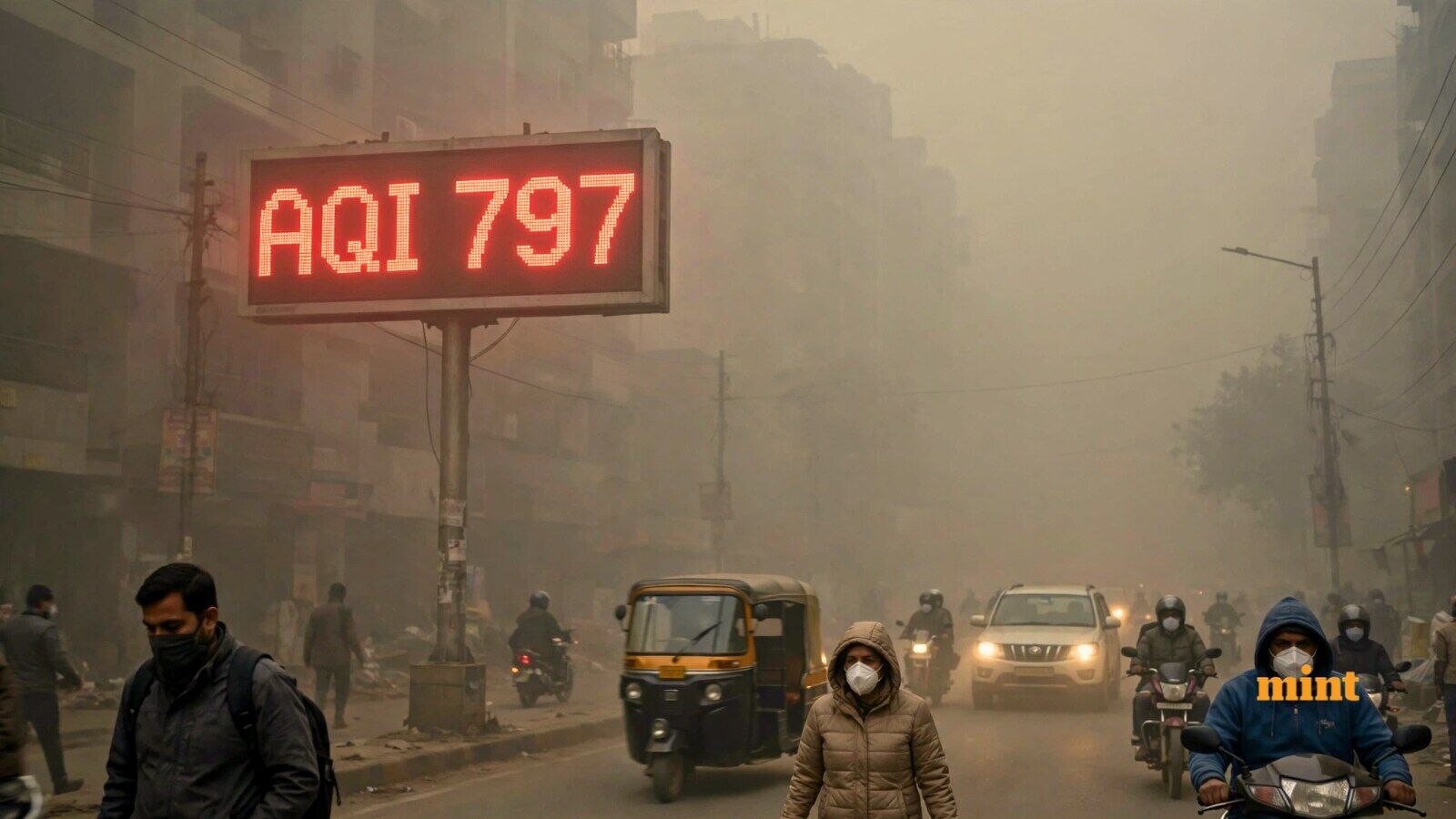
Delhi's air quality was hazardous on Sunday morning, with a citywide live AQI of 522 recorded by AQI.in on November 29 at 8:01 AM. New Delhi ranked 12th among the world's most polluted cities at the time. Several neighbourhoods fell in the hazardous category, which begins at 301 on this scale: Baljit Nagar recorded 797, Railway Colony 745, Punjabi Bagh Cooperative Housing Society 719 and Than Singh Nagar 635. Even the lowest of these neighbourhood readings was 113 points above the citywide figure.
The neighbourhoods had seen pollution ease on Saturday before rising again overnight. Baljit Nagar's AQI dipped below 300 before climbing back towards 800 by Sunday morning, while Railway Colony fell close to 200 before rebounding above 700. Than Singh Nagar also dropped close to 200 before returning above 600, and Punjabi Bagh fell below 300 before climbing back above 700.
Delhi's citywide PM2.5 level stood at 336 micrograms per cubic metre, while PM10 was higher at 471. AQI.in put that PM10 level at more than 10 times the World Health Organization's guideline of 45 micrograms per cubic metre. Baljit Nagar had the highest readings for both particles among the four neighbourhoods, at 474 for PM2.5 and 664 for PM10, followed by Railway Colony at 449 and 628, Punjabi Bagh at 435 and 610, and Than Singh Nagar at 393 and 551.
Saturday's daily AQI was 378, up 128 points from Friday's 250. Delhi recorded 235 on Tuesday, 226 on Wednesday and 240 on Thursday, and November 9 had the highest daily reading through November 28 at 666. Among Indian metros listed by AQI.in, Delhi had the highest AQI, followed by Pune at 197, Hyderabad at 182, Bengaluru at 173, Mumbai at 172, Chennai at 171, Kolkata at 162 and Ahmedabad at 152. The city was sunny at the time, with a temperature of 25°C and wind speed of just 3.6 km/h. AQI.in estimated that continuous exposure over 24 hours was comparable to smoking 12.6 cigarettes, using the average PM2.5 level over that period and crediting Berkeley Earth for the comparison.